

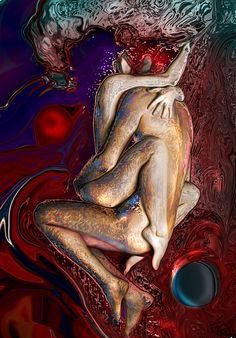
I red her words,
Always a green to be hers,
Even if she is blue,
I’ll make her feel all white,
I rose to the occasion,
Orange you glad I did?
Now I pine for her touch,
Ivory decided,
Butter lips are like fire,
Stoking violet desire,
Olive in her thoughts,
And yellowed to the night,
When she tans my hide,
I mustered done something wrong,
I’ll sand and take it,
Gingerly fanning the flames,
I fawn over her beauty,
And want to be in cider,
I azure you it’s true,
So berry your doubts,
I’ll submit umber your will,
Never sable to imagine,
That you might pink me,
And now we cherry on together,
Swept along by the currant,
Just oat of reach,
Snow me the way,
And I’ll keep you safe from the gold,
As we dance in the colors,
View original post 6 more words

 image: Padre’s Ramblings

 Interestingly, you will find many invented poetry forms tend not to be created brand new from whole cloth, but rather are either a variation on an existing traditional form or a mash-up of two different ones. The former is certainly true about a form I recently discovered while perusing Miller Williams’ excellent book “Patterns of Poetry: An Encyclopedia of Forms”. Created by the British scholar, publisher, and light verse poet Frank Sidgwick in the early 20th century, the monosyllabic sonnet (also known as a word sonnet) follows most of the rules of a traditional sonnet with one exception (as its name indicates). It has 14 lines and usually uses either the rhyme scheme of an Italian or English sonnet, but each line consists of just one syllable instead of the 10 syllables of iambic pentameter. You may notice I said, “usually uses either the rhyme scheme of an…


 Photo by
  Fae Corps Publishing